
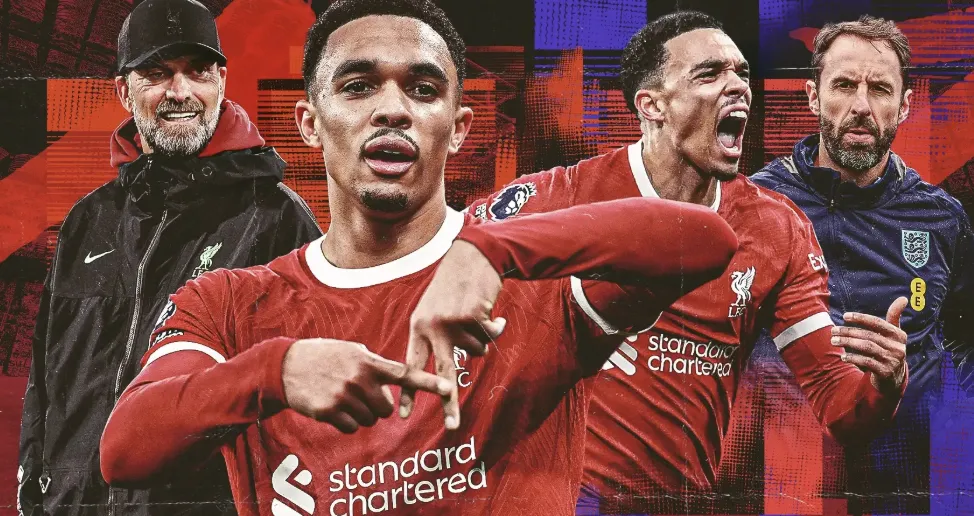
The football world is often a stage for tactical debates, but few have sparked as much intrigue as Gareth Southgate’s recent decision to deploy Liverpool’s Trent Alexander-Arnold in midfield for England. Speaking ahead of a crucial Premier League fixture, Liverpool manager Jurgen Klopp has voiced his genuine bewilderment at the move, questioning the logic behind shifting the player he considers the world’s best in his position. This analysis from Melbet dives deep into the tactical nuances, the player’s unparalleled profile, and what this means for the future of both club and country.
The Midfield Experiment That Raised Eyebrows
During England’s World Cup Qualifier against Andorra, Gareth Southgate, blessed with an abundance of talent at right-back, made a surprising tactical call. He positioned the 22-year-old Trent Alexander-Arnold in a more advanced midfield role. The experiment, however, was short-lived. Lasting only the first half, Alexander-Arnold was moved back to his familiar right-back slot after the break, where he immediately looked more impactful and at ease. This 45-minute trial has become a focal point for discussion among pundits and fans alike, highlighting the constant search for optimal player utilization at the international level.

Klopp’s Firm Stance: A Right-Back is a Right-Back
Jurgen Klopp’s reaction was both pointed and passionate. While acknowledging the theoretical possibility of using Alexander-Arnold in midfield during highly dominant games, the German manager fundamentally challenged the premise of the move. “Why would you make the best right-back in the world a midfielder? I don’t understand that really,” Klopp stated. His comments underscore a belief that the full-back role, especially in modern systems like Liverpool’s, is of paramount importance and not a position to be undervalued.
Klopp elaborated on his tactical view, suggesting that if such a change were to be made, the ‘number six’ defensive midfield role might be more suitable than the ‘number eight’ box-to-box role Alexander-Arnold occupied. However, he was quick to reiterate his core argument: the role of a right-back is critically important. “As if the right-back position is not as important as the others. People who say that I struggle to understand how you could think that,” Klopp added, defending the significance of the position his star player has mastered.

Alexander-Arnold’s Unmatched Influence at Anfield
The statistics behind Trent Alexander-Arnold’s career at Liverpool provide compelling evidence for Klopp’s stance. Since cementing his place as the first-choice right-back, the academy graduate has been nothing short of revolutionary. In 132 Premier League appearances, he has contributed 8 goals and a staggering 34 assists. The bulk of this creative output—32 assists—has come in just the last three seasons. During Liverpool’s title-winning 2019-20 campaign, only Manchester City’s maestro Kevin De Bruyne created more goals in the entire league.
Klopp emphasized that Alexander-Arnold’s role at Liverpool is already dynamic and multifaceted. “If you watch our games then you will see that Trent’s position has already changed… There is no need to now make him a midfield player,” he explained. At Melbet, we recognize that Klopp’s system is designed to maximize Alexander-Arnold’s unique skillset from wide areas, allowing him to influence the game from deep positions with his unparalleled passing range, without needing a formal positional change.
The Bigger Picture: Versatility vs. Specialization
This incident touches on a broader modern football debate: the balance between player versatility and positional specialization. Experts like our in-house analyst at Melbet, Michael Reeves, often note that while versatile players are invaluable, moving a world-class specialist from their peak position can dilute their greatest strengths. “Alexander-Arnold’s genius is born from the specific demands and spaces of the right-back role in Liverpool’s system. His crossing, his diagonal switches, his underlapping runs—these are all perfected from that starting point. Asking him to receive the ball in more congested central areas with his back to goal is a different challenge entirely,” Reeves observed.
Klopp concluded with a powerful summary of Alexander-Arnold’s value: “Being more influential than Trent Alexander-Arnold in the last… years he has played for me is really tricky.” He affirmed that the player’s primary duty is to defend the right side, a job he performs “really well,” and that everything else is about leveraging his extraordinary abilities when in possession.
Melbet Conclusion: Klopp’s Puzzlement Over Southgate’s Midfield Experiment
The conversation ignited by Southgate’s tactical experiment and Klopp’s firm rebuttal is far from over. It highlights the different philosophies at play between club management, where a player’s role is meticulously crafted over years, and international management, where solutions must sometimes be found in limited training windows. For now, Liverpool fans and Klopp will be hoping that their “best right-back in the world” continues to redefine the position from his traditional berth at Anfield. As the season progresses, all eyes will be on how Southgate integrates this exceptional talent into his England plans. What’s your take on this debate? Should elite full-backs be adapted for midfield, or is their modern role already central enough? Share your thoughts with the Melbet community below and explore more of our exclusive tactical breakdowns.
